|
Breech
Delivery
Breech babies can present in a variety of
ways, including buttocks first, one leg or both legs
first.
Frank breech means the buttocks are
presenting and the legs are up along the fetal chest.
This is the safest position for breech delivery.
If either foot is presenting ("footling
breech"), there are increased risks of umbilical cord
prolapse and delivery of the feet through an
incompletely dilated cervix, leading to arm or head
entrapment. Because of the risks of breech delivery, in
many civilian hospitals most or all breech babies are
born by cesarean section. In operational settings,
cesarean section may not be available or may be more
dangerous than performing a vaginal breech delivery.
The simplest breech delivery is called a
spontaneous breech. The mother pushes the baby out with
the normal bearing down efforts and the baby is simply
supported until it is completely free of the birth
canal. These babies pretty much deliver themselves.
This works best with smaller babies,
mothers who have delivered in the past, and frank breech
presentation.
If the breech baby gets stuck half-way out,
or if there is a need to speed the delivery, an
"assisted breech" delivery is performed. For this type
of delivery, it is very helpful to have a second person
to aid you.
A generous episiotomy will give you more
room to work, but may be unnecessary if the vulva is
very stretchy and compliant.
|
|
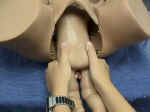
Grasp the baby so that your
thumbs are over the baby's hips. Rotate the
torso so the baby is face down in the birth
canal.
A towel can be wrapped around
the lower body to give the you a more stable
grip.
|
|
|
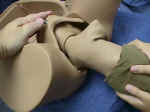
Have your assistant apply
suprapubic pressure to keep the fetal head
flexed.
Exert gentle outward traction
on the baby while rotating the baby first
clockwise and then counterclockwise a few
degrees to free up the arms.
If the arms are trapped in the
birth canal, you may need to reach up along
the side of the baby and sweep them, one at
a time, across the chest and out of the
vagina.
|
|
|
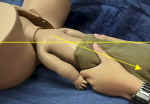
It is important to keep you
hands low on the baby's hips. If you grasp
the baby above the hips, it is relatively
easy to cause soft tissue injury to the
abdominal organs, including the kidneys.
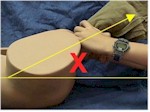
During the delivery, always
keep the baby at or below the horizontal
plane or axis of the birth canal.
|
|
|
If you bring the baby's body
above the horizontal axis, you risk injuring
the baby's spine.
Only when the baby's nose and
mouth are visible at the introitus is it
wise to bring the body up.
The application of suprapubic
pressure by the assistant is important for
keeping the head flexed against the chest,
expediting delivery, and reducing the risk
spinal injury.
At this stage, the baby is
still unable to breath and the umbilical
cord is likely occluded.
Without rushing, move steadily
toward a prompt delivery.
Placing your finger in the
baby's mouth may help you control the
delivery of the head.
Try not to let the head "pop"
out of the birth canal. A slower, controlled
delivery is less traumatic.
|
|